Define the observable requirement
Start with what must be true, what can be measured, and which constraints cannot be traded away.
Approach
The operating principle is simple: understand the requirement, test the smallest useful system, measure real behavior, then automate only what has earned automation.
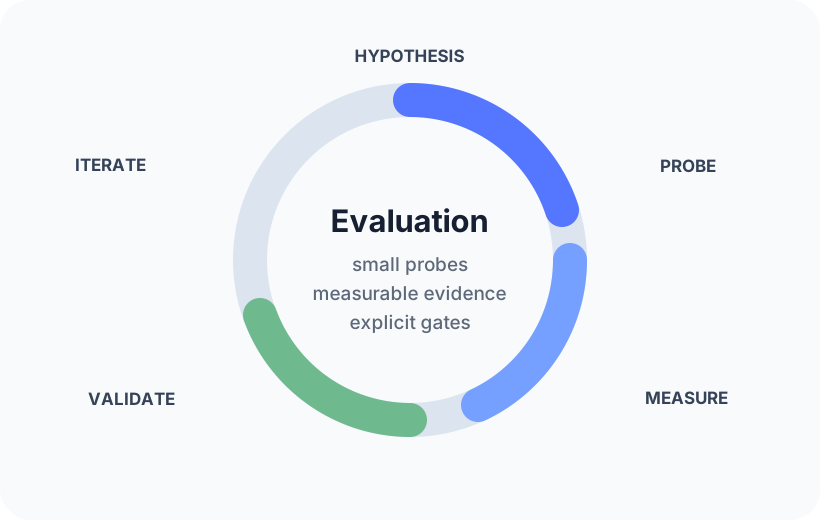
Start with what must be true, what can be measured, and which constraints cannot be traded away.
Use the smallest experiment that can expose whether the approach works in the real environment.
Record the configuration, inputs, outputs, failure modes and validation results needed to compare runs.
Only after the need is demonstrated: turn recurring, well-understood steps into a controlled pipeline.
Prefer bounded retries, deterministic checks and visible state over silent fallback or open-ended automation.
Engineering principles
If a property can be checked exactly, use code rather than opinion.
Keep enough execution context to explain and reproduce important outputs.
Choose execution routes based on capability and constraints rather than making one provider the architecture.
Reserve expensive inference or cloud resources for tasks that actually benefit from them.
Classify why a route failed before replacing it or widening the system.
Avoid adding infrastructure until a real requirement demonstrates the need.