01
AI orchestration
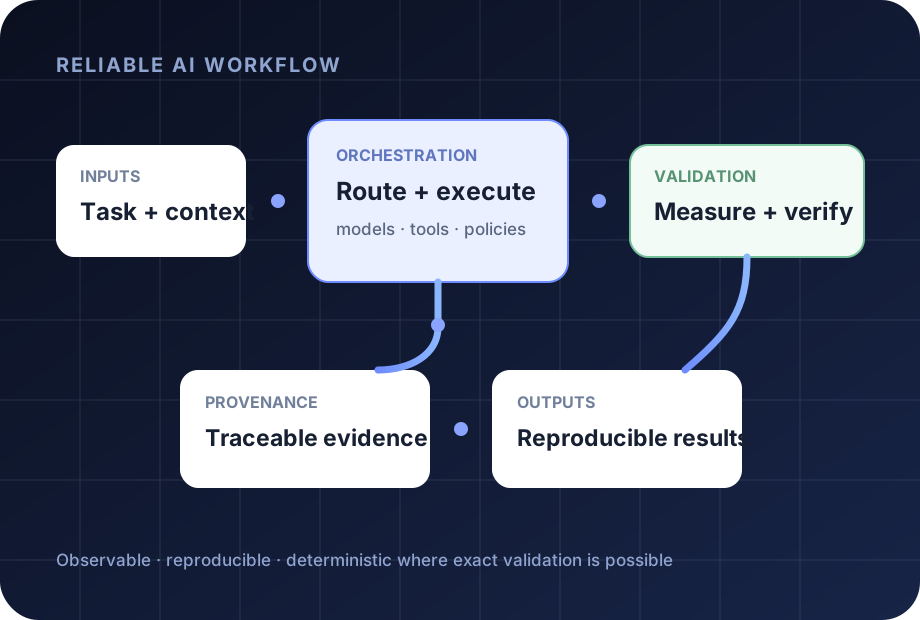
Controlled orchestration across heterogeneous execution environments.
How it is approached →Independent software R&D focused on orchestration, reproducible pipelines, model evaluation, local/cloud integration and deterministic validation.
Capabilities
The work is centered on the operational layer that turns individual AI calls into controlled software workflows.
Controlled orchestration across heterogeneous execution environments.
How it is approached →Reproducible workflows with traceable outcomes and repeatable checks.
See the evidence model →Measurable probes and deterministic gates around probabilistic systems.
Explore validation →Capability- and cost-aware routing across execution environments.
Explore integration →Approach
Prototype small, measure real behavior, automate only after the need is demonstrated, and keep failure explicit.
Read the full approachStart with what must be true and what can actually be measured.
Use the smallest useful experiment before adding infrastructure.
Preserve enough context to compare, diagnose and reproduce.
Turn demonstrated repetition into controlled pipelines.
Research notes
Public notes explain the engineering principles behind the activity without presenting internal prototypes as commercial products or customer work.
Separate semantic judgement from exact validation.
ReproducibilityReproducibility is more than saving the final outputPreserve the execution chain that makes comparison meaningful.
ArchitectureLocal and cloud systems as execution routesKeep task contracts explicit without erasing capability differences.
Recent R&D activity
Dated engineering updates show what has been qualified, improved or contained without exposing private project content or implementation recipes.
Application domains
Current status
Software systems and internal prototypes are in active development.
Contact